🚀 Kubernetes Architecture Made Simple
Kubernetes works like a well-organized system where responsibilities are clearly divided between decision-making and execution.
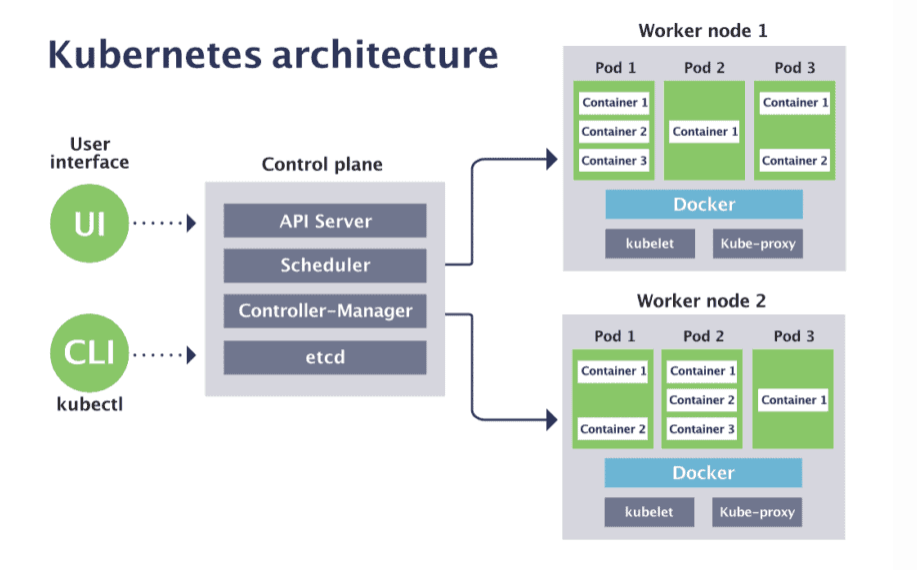
At the top lies the Control Plane, which acts as the brain of the cluster. It receives user requests through the API server, decides where workloads should run using the scheduler, and continuously ensures that the cluster stays in the desired state via controllers.
The actual execution happens on Nodes, which are worker machines responsible for running containerized applications.
Each node contains three critical components:
Kubelet – ensures that containers are running as expected by communicating with the control plane
Container Runtime – the engine responsible for running containers
Kube-proxy – manages networking and ensures traffic reaches the correct application
Users interact with the cluster using kubectl, which acts as a command-line interface to send instructions to the control plane.
In short:
The control plane makes decisions, nodes execute them, and kubectl acts as the bridge between the user and the cluster.
👉 “kubectl talks → Control Plane decides → Node executes → Kubelet manages → Runtime runs → Proxy connects”
Trick to remember everything in 1 go [in marathi]--
**Control Plane = ASK + E
“ASK-E = Boss + Memory”
🔹 ASK (Decision makers)
A → API Server [validates your requests and routes them to right place ]
S → Scheduler [ finds the best worker node for it ]
K → Controller Manager [ create, delete, or update resources according to desired state]
🔹 E → etcd
Cluster ची memory / database
सगळा state इथे store होतो [keeps track of everything in cluster]
📌 Final:
👉 Control Plane = ASK + etcd (Brain + Memory)
** Node = MRP + IPT
“MRP-IPT = Worker + Network rules”
🔹 MRP (Work execution)
M → Kubelet (Manager) [ensures containers running r healthy nd up to date]
R → Container Runtime (Runner) [runs the actual containers docker, containerd , etc]
P → Kube-proxy (Proxy) [ ensures every pod can talk to other pods and services inside cluster]
🔹 IPT → iptables
Network rules बनवतो (traffic कुठे जायचं)
kube-proxy internally iptables वापरतो
📌 Final:
👉 Node = MRP + IPT (Work + Traffic control)
**FULL FLOW (Ultimate Story 🎬)
👉 ही story visualize कर:
मी (kubectl) → बॉसकडे गेलो
बॉस (API) → memory (etcd) check करतो
काम assign (Scheduler) करतो
Worker node कडे जातं
Manager (Kubelet) काम घेतो
Machine (Runtime) काम करतो
Network (Proxy + iptables) delivery करतो
** Clean Diagram
🧠 CONTROL PLANE (ASK + E)
[ API | Scheduler | Controller | etcd ]
                ↓
🏭 NODE (MRP + IPT)
[ Kubelet | Runtime | Proxy | iptables ]
Comments
Join the discussionNo comments yet. Be the first to comment.